"All war is deception"

Showing posts with label real time strategy. Show all posts

Tuesday, December 8, 2020

Asymmetry For Real Time Strategy Games

Asymmetry is more abstract than simply having heroes, so that's one reason why people don't talk about that as much. 

So I'll just give examples of asymmetry from the top of my head. Yes, I have played most of these games, though some more than others.
RTS games:
Starcraft 1+2, we all know about that. Protoss have shields. Zerg have creep. Etc.
Warcraft 3, resource gathering was different for each. The asymmetry was buried more in the details of each race, and each race had a clear counter for each unit type for the other race's units.
Warcraft 2, the clearest asymmetry are the late game spellcasters between the two races. Otherwise fairly the same.
Dune 2 is the same, factions are the same except for the 3 unique units for each faction.
Tiberian Sun (Command and Conquer 2), sort of the same thing, mostly the same in the beginning, but then branches out differently to each specialty for GDI's armor and Nod's stealth. Nod cyborg technology in particular gave a cross between infantry and vehicular endurance, and was countered by EMPs. The asymmetry was basically conventional versus unconventional weaponry.
Command and Conquer 3 continues GDI armor conventional and Nod stealth unconventional, but the alien Scrin offers asymmetry by having a flying construction unit and mind control units.
Red Alert 2, Allies have chrono technology (teleportation), Soviets have iron curtain tech (invincibility), Yuri has mind control. Other different technologies like Allies are close enough to their counterparts to not be too assymetrical, but it was still a nice touch (for example, a Prism Tower and Tesla Coil are charged differently but still have the same result, a beam of something towards an enemy).
Red Alert 3, Allies have cryo tech (freezing), Soviets have armor, Empire had a different construction mechanic entirely. Other asymmetry is more in the details.
Command and Conquer Generals have USA with lots and lots of drones that accompany units for support repair and fire and helicopters for resources, China with propaganda, nuclear radiation, and hacking (resources), GLA with chemical warfare, suicide units, and tunnel networks and quickly rebuildable structures but no air units.
Grey Goo, the Grey Goo faction basically reproduces. The Mother Goo/constructor's resources is the same as its health and they can eat enemy units. Beta have hard points they can use as defenses and uses hubs to build bases. Humans have teleportation and power conduits that give them centralized bases. The Shroud can build anywhere unlike other factions but only have slow extraction of resources unlike the harvesters of the other factions but cannot auto produce units like other factions.
Universe At War, each faction plays almost completely differently: Hierarchy has massive crawlers that function as the faction's structures and could crush other units, Novus uses a network to teleport around the map, Masari could change its entire faction into Light mode (attack) or Dark mode (defense) and each mode completely changes the faction's gameplay
Age of Mythology, there are five cultures, Greeks acquire worship by villagers assigned to temples, Egyptians acquire worship through monuments and have healer units, Norse have two resource gatherers and generic heroes that can be produced en masse and gain worship by killing enemies, Atlantean villagers do not need to return to a building to increase resources and can upgrade their normal soldiers to hero units and their town centers acquire worship, Chinese resource gatherers can drop off all resources at a single site and have gardens that gain all resources passively and have only one infantry unit (with all other units being archers) and the only culture with amphibious units.
Age of Empires have a lot of civilizations that are different details such as unique units and buildings and statistics, but there are commonalities. 3's Asian Dynasties civilizations have Consulates that receive shipments. 3's WarChief civilizations share canoes.
Dawn of War has 10 full factions. There is no clear asymmetry with just the mechanics, however the feel of each faction is definitely different.
Company of Heroes have different progression for Allies versus Axis. Armored and specialized Axis has three phases while versatile Allies usually plop a Barracks then Motor Pool.
Warrior Kings starts you off as a neutral faction. But by choosing to build a Church, you pledge yourself to the Imperials, or if you build a Maypole, pledge for Pagans, or if do the neutral route in the middle with a Guildhall for the Renaissance faction. And you can have a part Imperial and part Renaissance mix OR a part Pagan and part Renaissance mix, but no Imperial-Pagan mixing. The asymmetry here is that Renaissance is for sieges and heavy upgrades, Imperials holy units can exorcise demons and call upon Acts of God, equivalent to superweapons , and Pagans can swarm with demons and other massed cheap units.
Other games:
Civilization, each civilization is different in mostly statistics, but multiple victory conditions I believe offer the most asymmetry in a Civ game. There is a domination victory, cultural victory, religious victory, science victory, etc. So asymmetry is not limited only to factions.
Conquest of Elysium and Dominions series from Ilwinter Games have many, many factions for their strategy games that are almost completely asymmetric. They are balanced by making sure every unit has at least one hard counter *somewhere* in another race, not necessarily all races.
Endless series seems to master faction asymmetry in the 4X space. Each have different goals.
Dune board game factions had cards that had different effects on different factions, different victory conditions, and so on but have the same core gameplay.
Cthulhu Wars board game is the same, different victory conditions and yet even with same core gameplay, the factions play out very differently.
ROOT board game have completely different game mechanics for each player almost entirely. Some factions can't even transverse on the forests and have to be limited to the roads. Each player have totally different goals to win.
Among Us and other Mafia/Traitor games, there is an asymmetry between the Crewmates and Impostor. Both have almost totally different mechanics and tools, from doing tasks versus sabotages and killing. In other Traitor games like Salem, each player can have completely different roles and thus tools to win.
From that we get types of asymmetry:
Mechanical asymmetry - Games with players and factions that have completely different game mechanics from each other are probably my favorite.
Economic asymmetry - Players and factions that utilize the same resources differently and gather those resources differently. Age of Mythology shines in this.
Movement asymmetry - Factions that utilize different locomotions. For example, a faction may have air units and another has naval units but none for other factions. Another faction may have hover for their vehicles, making them able to cross water, instead of tracks. Factions that can teleport versus those that have no teleport is another example.
Weapons asymmetry - Players with specializations on different weapon types. For example, a melee heavy faction versus ranged faction. A siege faction versus a defensive faction. And weapon effects, too, for example, a piercing railgun that hits multiple enemies in a line versus a poison cloud that hits multiple enemies in a circle. You can have the same unit types but giving each a different weapon effect changes the battlefield completely.
Upgrades and technology asymmetry - Rare to have alone because it is not so impactful visually, but you can have the exact same units and everything but with different focuses on upgrades, such as more attack or more defense.
Unit type asymmetry - Sort of related to weapons asymmetry but more deliberate and wider. For example, an infantry heavy faction versus a vehicle heavy faction. It could even take the form of a faction with no heroes versus a faction with heroes.
Base Building asymmetry - This can take on the form of things like mobile structures like in Starcraft, limited construction areas like creep, or even different construction mechanics like Empire of the Sun nanoconstructors versus the traditional MCV of Allies and Soviets or a hub system versus a network system in Gray Goo.
Objectives asymmetry - As mentioned, Endless and Civilization has different victories, Among Us crew and imps have different goals. This is often paired with mechanical asymmetry but not always. Because of different victory conditions, players play differently.
Progression asymmetry - This is often tied to build orders. Company of Heroes has Allies with fairly straightforward progression, whilst Axis have three phases of progression. So mixing up things is an asymmetry, for example, a faction may get light vehicles before they get infantry, or aircraft before they get tanks. Rocketeer infantry/jetpack infantry rush is an example for Red Alert 2/TibSun for the latter. This is only progression and not unit type, for example, you can have two factions with the same exact units but different progressions, forcing a different gameplay.
Feeling asymmetry - You can have no mechanical asymmetry and have the same core gameplay mechanics but still a different feeling for each race by just having different stats. For example, heavily armored faction versus a stealthy hit and run faction are often popular archetypes. Or a melee heavy faction versus a ranged heavy faction. Same mechanics, different stats, different feels.
Map asymmetry - Or you can have no faction asymmetry whatsoever, and just have the map be asymmetrical. For example, a map with a different resource for each side.
Which asymmetry do you like? Which asymmetry do you not like?


Thursday, December 3, 2020

First Impressions: Rebel, Inc.

Rebel, Inc is a mobile real time strategy game loosely based on the endless wars in the Middle East. It is very reminiscent of Plague, Inc. Not sure if they are made by the same company. Anywho, it offers a far more degree of control than Plague, Inc.

You pick a leader, which has advantages, and a headquarters, and try to stabilize the region by upgrading the civilian and government. You fight off insurgents with military that try to destabilize it. 

The map is divided into sections or zones. Each zone is stabilized separately. A lot of upgrades are not instant. Some emanate from your headquarters outward to adjacent zones, eventually affecting other zones. So a road upgrade would first improve your roads at the headquarters, then the zones next to the headquarters, then the next ones, until all zones are upgraded. 

You have to manage corruption and inflation as well, which increases for each upgrade you buy. Corruption increases because of inefficiencies. Inflation increases when you rapidly buy upgrades rapidly that are related to each other. I like the balancing act this gives. 

Combat is simply drag and drop the military to a hostile area. Reinforcements are done by dropping military in adjacent areas. Upgrades unlock other weapons such as airstrikes and defenses such as garrisons. Insurgents must be cornered as they can flee to adjacent zones. 

All in all, good balance of management and light combat, great for mobile.

Tuesday, November 17, 2020

Individual Units or Squads or a Combo of Both?

In most older RTS games, you can only produce one unit at a time. The first "definitive" RTS game, Dune 2, had infantry as squads, but they weren't true squad units, because they were just a sprite/image of a squad, each sub-unit was not semi-independent.


Some newer RTS games let's you produce units as squads, such as C&C3 and Dawn of War. These squads when you select one unit in a squad, you select all the other units in the squad, they act as one unit with many sub-units. Each sub-unit had their own health and their own firing and were semi-independent.


Some have combinations of both. Starcraft has reactors where you can produce multiple marines at once. Of course, selecting multiple units make them in a sort of a squad. But that's not the default, of course, just that selected units sort of act like a squad. Carriers makes interceptors, so a carrier is basically like a squad unit.


I would like more squad units in more RTS games. But Blizzard RTS games are not known for squad units. If Frost Giant will stick to the individual unit philosophy, and have things like reactors and carriers to augment units, my preference is to normalize making batches of individual units from the very beginning. In a real war, (lower level) units come in batches, 10 at once, 20 at once, or whatever, not just a single soldier you train every so often. So instead of just training one marine in the beginning of the game and then cycle to the next marine, 10 will pop out the first training class. It will normalize massive firefights in the beginning like a real war, instead of a battle, to me, at least.

Saturday, November 14, 2020

If you want to make an RTS with mass wide appeal (rather than RTS gamer only appeal), look at Age of Empires and C&C

(In context of the new studio Frost Giant, a studio composed of former Blizzard developers looking to make the next great RTS)

While it is true Starcraft has far more current players today, it is arguable that Age of Empires and C&C have a wider mass appeal among non-gamers and non-RTS gamers. Current numbers would only be useful since there are no true new releases of both series that are not remakes or remasters (or the most recent titles from them do not capture the early spirit).

These are just anecdotal experiences, so you can take them with a grain of salt.

I run a fairly okay and generic RTS page, and AoE, C&C, and SC is the order of ranking in popularity in regards to posts made on there. So that's one indication.

I am not a gamer (as in someone who spends half his day gaming, cause I have work and live a fairly normal life), so I meet a lot of non-gamers and non-RTS gamers (ie someone who would play, say, Call of Duty rather than a strategy game) in my circles.

A lot of older non-gamers I've met have played and enjoyed Age of Empires with fond memory, even though they don't play any games anymore (quite a few of them were politicians, might give you an idea what line of work I used to do) but would not touch other strategy games. A lot of the reasons they would give me is that they learned history from it. Quite a few also have played Civilization alongside it, which makes sense. But they would never touch Starcraft.

Now, another trend I've seen were those who were older gamers, but not RTS gamers, again, those who would usually play something mainstream like Call of Duty rather than a strategy game. They usually gravitated to the Command and Conquer series back in the day when it was popular, particularly Red Alert 2. But not Starcraft. Some of the reasons they gave me were it was patriotic (the America versus Soviet timeline). The ones who were not into Red Alert were into Tiberian C&C's story of Kane. But they would never touch Starcraft.

So most normal people really like history. There's a reason why World War 2 games come out every year. Should Frost Giant's game be based on realism and history? Not necessarily, but it is to be considered that Starcraft's science fiction does go over the head of a lot of people. You can talk Marauders and Reapers and what have you and most people will look at you strange, while the AoE archers, musketeers, and knights people would immediately recognize what they would do. Red Alert 2 was a bit whacky, but soldiers with guns and tanks are fairly easy to understand. You have to learn basically a three new cultures for each race in Starcraft, Terrans are recognizable cause humans, and they have soldiers with guns and tanks. But Protoss and Zerg are basically homework if you want to learn how to play them. Of course, making it historical and realistic will limit gameplay, as well (unless you are creative). But the post is about accessibility to mass wide appeal. If a balance can be struck, then do so.

Those are my anecdotal experiences. It is clear to me that most Starcraft players in contrast, are RTS gamers. That's not a bad thing, don't get me wrong. I love all RTS games, as I said, I run a generic RTS game page myself. I've played almost all of them at least once, even the very obscure ones, though I keep finding even more obscure ones to this very day.

But one non-anecdote is how Microsoft made Age of Empires mass appeal. There was a very old article that I can't find anymore where Microsoft had every demographic do quality testing for Age of Empires. In that article, an old grandma was interviewed who tested the game, and it apparently went really well that she was able to play the campaign missions and hold off her own in a multiplayer match for at least 15 minutes before she succumbed. That's how strong the tutorials and pacing were in Age of Empires. Now, a grandma is probably not Frost Giant's target audience (and neither was her Age of Empires' audience), but can it really be said that a very old person can access Starcraft enough to be able to hold their own for a few minutes?

So if Frost Giant just wants to target RTS gamers, which is not a bad thing at all, and create a spiritual successor to Starcraft, with esports scene and all that, then that's totally fine. That's what they are experts on. I'll definitely still play it.

But if they want to reach non-gamers and non-RTS gamers, they need to look at how AoE and C&C do things, maybe not necessarily in terms of gameplay, but in terms of tutorials and accessibility (for AoE) and theming (for C&C).

Monday, November 9, 2020

Many Pitfalls of Conspiracy Strategy Games: Secret Societies, Subterfuge, Traitors, Etc.


There has been a fascination for strategy games that let you mastermind a conspiracy. Who doesn't want to be an evil puppet master behind the scenes? 

However fascinating the ideas are, there are very few dedicated games for it, and those dedicated ones... arguably aren't very good.

Elements of Conspiracy Strategy Games

A conspiracy strategy game usually has the following I have noticed:

Behind The Scenes - In a conspiracy strategy game, you are often not one of the "major players" in the world stage. You are not a king, or a country, or a military commander. You are an advisor, a grandmaster, a priest, a prophet, a cult leader behind the thrones. Your goal is often to affect the major players to bow down to your will. 

Indirect Influence - To convince the "major players", you will need to convince them. One way to do this is automatically. In Civilization, a neighboring city may come over to your side because of your strong cultural influence in a number of turns. Another is to do it manually, you order agents to convince the major player, through seduction, bribes, blackmail. 

Voting - Because conspiracy games are about influence, a lot of them have voting somewhere, where it shows if your influence actually works. 

Multiple Map Overlays - Because there is something as behind the scenes, there is often at least one other map overlay. For example, in Civilization, a religious map and cultural map will show the different kinds of influences.

Agents - Agents do things. They are spies. They are assassins. They are diplomats. They are cultists. They are information brokers. They are prophets and preachers to convert the flock. They can often do a lot of things and are not specialized.

Information Warfare - Because conspiracy strategy games are all about subterfuge, information warfare is king. At its basic level, this would be the fog of war that conceals enemy units. 

Examples

What are some examples of conspiracy strategy games or strategy games with subterfuge elements?

Game of Thrones: Genesis was a failed product. It was very convoluted.You gain prestige, and the methods to get that prestige were very arcane, at best. There was a war aspect, but the subterfuge aspect confused everyone. There are so many moving parts. It seems automation would help this.

Shadow Council The Puppeteers is an okay indie strategy game. It's very click to do something, and boom, you increased influence. Yeah, very much an oversimplified spreadsheet game.

Shadows Behind The Throne suffers from your actions not having very clear effects at all. You make nobles vote to ignore the Lovecraftian army you are creating. While that sounds sort of exciting, it's not. Lots of micromanagement. 

Republic: The Revolution was a really cool political RTS. You canvassed neighborhoods and got votes in order to enact a revolution in an alternate history East European country.

Left Behind: Eternal Forces was very similar to Republic: The Revolution. You prayed and converted people to your side. It was just very tedious to do that. It seems automatic preaching and conversion would have helped from the beginning. But it was a story-based game, so that could be forgiven.

Conspiracrat: A Game of Secret Machinations is a game of my own making. There should have been better objectives, like causing an actual war and nuclear warfare, rather than just accumulating much money and power. Ordering agents was tedious.

Offworld Trading Company was probably the best non-violent RTS I have played. The interplay between trading felt visceral. There was clear objectives and progress. Subterfuge also had clear results. An EMP bomb would disable my opponent's buildings very clearly.

Secret Government is a recent grand strategy game in the same vein. Early Access reviews show it is mostly positive. Time will tell if it actually will last the test of time.

Crusader Kings and similar Paradox games seem to be long lasting, but they are very convoluted for the average player.

The more warlike RUSE offers a solution, while combat would be a thing, give commanders more explicit information destroying abilities such as "fake armies". Many RTS games have some form of information disruption, but RUSE makes it front and center.

There was a simple Flash game, I'm not sure what it was called, but I think it was called "Third Party" or "Third Side" where you played both sides in a war and you had to balance the war so one side would not win and so you could get an endless war. Units fought automatically. You were given a random unit and you can place the unit on the left or right side, so if you place it on the left side, it will fight for the left side, and vice versa. If you balanced it long enough, a nuclear war starts and you win.

Among Us isn't strictly a strategy game, but it is a strategy game. It is a traitor game like Mafia. It's ideas on how to play an Impostor, Sabotages, and the voting system can be translated into a gameplay with multiple units.

Proposed Solutions

What are some solutions to the pitfalls of conspiracy strategy games?

Less Micromanagement, More Macromanagement: In many conspiracy strategy games, you have many agents working for you. Clicking and ordering your agents is tedious and gets overwhelming the more agents you get. We will get to more specific details how on the next points.

More Automation: Agents are agents for a reason. They need to be independent. Have them bribe automatically. Have them infiltrate automatically. Have them assassinate automatically. And so on.

A lot of other things in conspiracy strategy games can be automated as well. We look at automating voting last.

Agent Specialization: Another way to lessen micromanagement is to make agents specialized rather than all-around hero units with many abilities. So spies always spy, assassins always assassinate, etc. rather than have agents that can do all these.

For converter units, it is very tedious to keep clicking to convert other units, when in the end, those units are just walking resources. See converter units as harvesters rather than hero units in their own right.

More Strategy, Less Tactics With Planners: This ties to both micro and macro as well, and even automation, but it is beyond those. Strategy means you can set an overarching goal with actual planning. Strategy games do not have planners. They really need to.

A planner would where you can choose objectives or goals or layouts or loadouts (whatever you need to prepare) before the game that every unit would know beforehand. Most planners in strategy games just consist of loadouts, such as for XCOM.

Maybe the goal is nuclear war. You choose "nuclear war" in your planner as an objective. Then all your agents would work with that plan in mind. Diplomats would automatically tell rulers to consider nuclear war. Sabotages would target nuclear silos immediately.

There should be a planner in-game as well so that changes to the master plan that would immediately affect everyone. If I want to switch from "nuclear war" to "make a one world government", I should just be able to do it with a button.

Real-time strategy games have always leaned towards tactics, command this building to produce this single unit, command this unit to go here, etc. A focus on strategy would make this less of a hassle. For example, switching to a "mobilized vehicle strategy" from an "infantry strategy" can be done with a button, changing all your unit production into vehicles rather than going to each factory to make vehicles and going to each barracks to stop infantry production. 

Information Warfare Progression

There should be no or little information warfare in the beginning. Only when it is near the end should complete "plot twists" be accessible and reveal themselves. Conspiracy strategy games like to throw you to a complete subterfuge mode where everyone is a double agent.

This would be a good progression:

Start - Everyone on the map has clear allegiances. When you send agents to convert someone, they fully convert to your side with no question.

Mid-game - Making more fog of war, some people have unclear allegiances because multiple sides are vying for them. 

End-game - Most people are close to their end game objective (nuclear war), secret agreements and double agents can now be a thing, where some people seemed to be working for you, when they were sleeper agents. And they will be revealed as double agents and sleeper agents when they act (or close to it), rather than it being hidden the whole time so that enemies can react and don't feel too bamboozled.

A system like DEFCON where you are allowed to use some things depending on DEFCON level would probably work in some capacity, but you can design it naturally as well.

Make Soft Power More Impactful and Deterministic, Not Probabilistic:

It is hard to show "soft power" and "indirect influence" and making them impact hard. Religious and cultural victories in Civilization are often maligned because influence mechanics are just not hard hitting. This is probabilistic and not deterministic.

Rather than, say, influence giving you a vote, have it that those you have influenced always vote like you. Or even better, they always vote according to your planned strategy.

There also needs to be a lot of UI that indicates this. For example, mind control lines like in Red Alert Yuri's Revenge clearly shows who is in control of a unit. A place getting cultural influence in Civ should have the number of turns shown when it will convert.

Reduce Voting In General (Or Turn It Into A Resource Rather Than A Game Stopper)

Showing influence's impact to just culminate in a single vote is anticlimatic. Often, the game pauses just for a vote so you could choose. And often, that vote doesn't do much of anything impactful, maybe just +1 Economy. Whoppee.

Instead of influencing "major powers" just to vote on some proposal, influence them to do more concrete things like pressing a nuclear button for war immediately. Or if you still want votes system of gameplay, make them vote automatically for your benefit (and planner strategy) without you having to click to choose (thus more automation). Turn votes into a resource and a number than something you have to pause the game for (which Shadows Behind The Throne is particularly bad at).

So if your strategy is nuclear war, agents and the influenced will always vote for it. If it's a vote for something like +1 economy for you and -1 economy for everyone, then they will always vote for +1 economy for you. Of course, there may be a subtlety here, that they would vote for themselves if it affects them if the against vote makes them get -1 economy, but for things that do not affect them, they would vote for you.


Saturday, December 8, 2018

First Impressions: Bad North


Bad North is a small, procedurally generated, minimalistic real time tactics and turn based strategy game. Yes, a real time tactics game. Let me explain.

What makes it different from normal RTS games is notable.

There is no group select, or rather, each unit is a squad, and you can only select one squad at a time. Time slows down if you select a squad to order them considerably.

Battle maps are small, even bite-sized. You can see everything in one glance, except for the parts hidden by cliffs, which makes the camera rotation mechanic vital and replaces the fog of war concept.

The rock-paper-scissors balance is also very apparent and significant, and will punish you if you aren't careful. Archers beat pikemen and swordsmen without shields, until they are close enough to damage the archers. Pikemen beat any melee units, like swordsmen with shields, except when they are moving, so they must be prepared and grounded in a position to be effective. Swordsmen with shields beat archers by shrugging off their arrows. Swordsmen, the "weakest" unit in the game, wins through overwhelming and outnumbering numbers, and also used to rush archers and moving pikemen. You can upgrade swordsmen's class to archers, pikemen, or swordsmen with shields.

The strategy layer is turn based. Here, you can choose which next location to defend. Then you can also choose your commanders, which command your squads, and upgrade them to different unit classes. You can also further equip them with skills and items.

You only start with two commanders/squads, however, and you must pick up new commanders along the way. There is a limit of four squads per island.

There is permadeath, so if you make a mistake, your squads die, all with its upgrades. You can replenish your units in battle through the houses you defend in the midst of the skirmish, though this takes considerable amount of time.

Once al your commanders are dead, it is game over.

One of my problems with the game is that the interface when selecting units is farther down the screen, and it is not really that noticeable. So to replenish or flee, you must go all the way to the bottom.

Other than that, Bad North is enjoyable. I really like the "time slows down when giving orders" mechanic. It seems to hearken to my previous post's point about orders having a pause: Possible Solutions For Preventing A "Clickfest" RTS

Friday, November 9, 2018

Possible Solutions For Preventing A "Clickfest" RTS

I've been trying to generate ideas on how to prevent the clickfest of an RTS and provide a better pacing.

So, assuming classic RTS gameplay (basebuilding, resource, etc.), in addition to that, I propose:
1. Pre-planning or (actual) strategy phase

In real warfare, there is more planning than simply just going down on the battlefield and hoping for the best (which is tactics, not strategy).

So taking a cue from board games and the like, a pre-planning phase would go a great length in the strategic aspect of an RTS. So, your opponent can plan out his moves, and you can plan out yours, before gameplay starts, giving each equal ground.

I would equate this as having a pre-planned opening in chess.

What can go into a phase, perhaps?
A. A predetermined base architecture/structure layout

With basebuilding in current RTSes, often, it is part of a reactive action. You have a build order you have to build, and if you spend too long placing units here or there, you forget to build proactively.

So instead, how about planning the base layout in advance? Like in real warfare?

Prison Architect has a function where you can place tiles to plan out where you want to build future structures while pausing the game. So something like that.

So instead of worrying whether you can click faster than another player to build a power plant or two, have the planned ahead.

And, if a base layout is good enough, saving and loading base layouts might be a thing.
Image result for prison architect planning

B. Pre-determined build orders

Like base layout, why can't the build orders also be pre-planned?

If your strategy is based on pumping out several units of the same type, say, siege units, or whatever, why not just have it set in the beginning and automated?

So instead of having the reaction immediate, an opposing player can plan to be in a defensive position instead. But most importantly, both are prepared to win (or fail), equally.
It might just involve setting up sliders or toggles for each unit.

C. Pre-determined scouting/attack routes

So, once structure and unit build order is done, why not attacks and scouting?

Once the pre-planning phase is done, the AI will automatically build your custom layout in the order and optimized. So whatever advantage you have clicking fast will be nil.

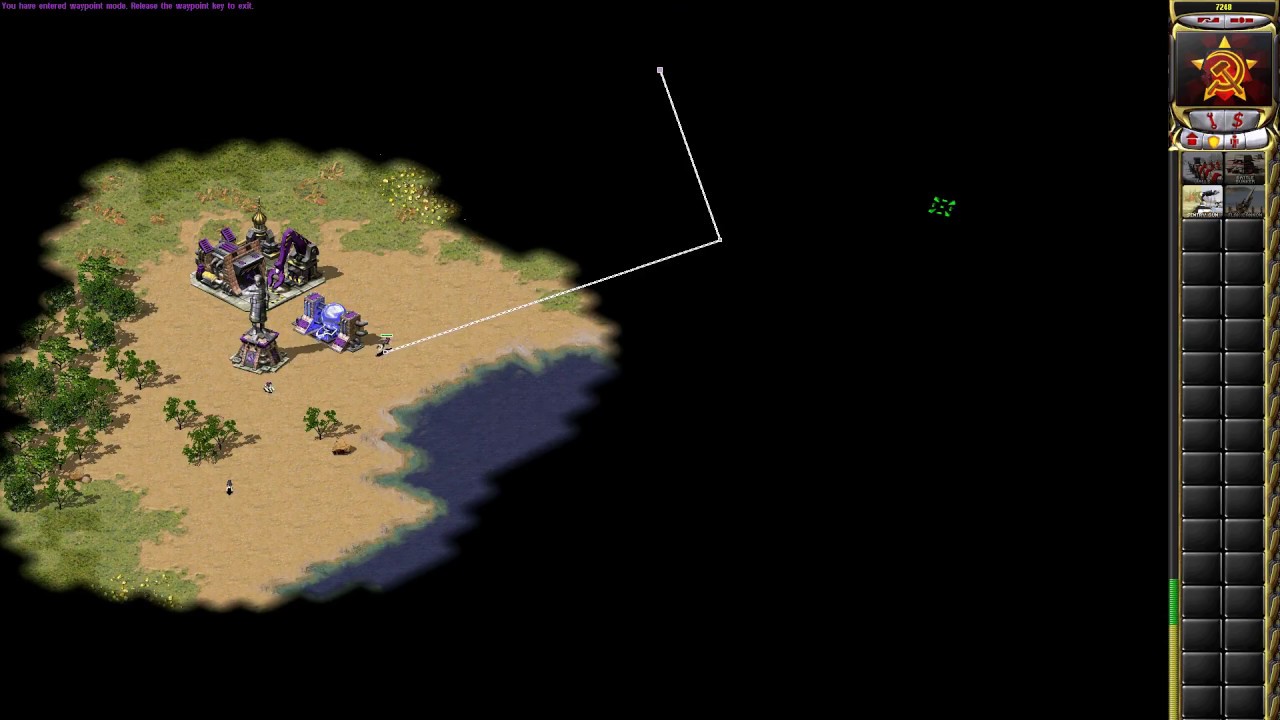
Games with a waypoint mode like Red Alert 2 is sort of like that. Except this will happen before gameplay starts.

Image result for waypoint mode red alert 2

Now, I'm not saying throw away all the micro. I would think a commander can override the macro orders. But planning ahead would be advantageous.

But if we want to extend it to the realtime gameplay:
2. A staggered or modified command system

A. Action points?
This might make an RTS a bit more turn-based. But just a bit.

We know in TBS games that there is such a thing as action points that limits actions per turn.

So, can something like that be applicable to an RTS?

How about something like a limited amount of clicks per minute or some sort?

Might be some balance issues there, and definitely a lot of RTS players might get annoyed, depending on how it is implemented.

B. More generalistic/macro actions
In real warfare, you can't really micromanage your soldiers too much. Most of the time, commanders give a sort of general command.

The Majesty games has it where you pin a flag on the ground and reward bounties to heroes or such that take up the call to arms. A general macro attack command might work that way.

It might take better AI for other actions. A general command to improve economy (compared to microing harvesters) might take building and commanding harvester units, building more refineries, etc. Apparently, Distant Worlds does a good job.

C. Ability to order while pausing games
This will really only work for single player games, unless the pause is mandatory for all players. And this has already been done in some obscure RTS games I don't remember the name of. But the ability to give orders while pausing can give players a breather.

Maybe pausing can also switch to the planning mode I proposed. So once paused, you can do more build orders, structure layouts, and attack formations.

If there is mandatory pausing for multiplayer games, it might take the form of a turn-based game where you are given 15-minute (or so) bursts of real time activity and then a mandatory pause for planning mode.

In Conclusion:
These are just some solutions I propose to prevent RTS games becoming clickfest. Will they be effective? Well, it depends.

Wednesday, May 16, 2018

Game: Actions Per Minute: The RTS


Actions Per Minute: The RTS 


Real time strategy games have a tendency to be accused of being clickfests and that a higher APM (actions per minute) is the thing that wins games in RTSes rather than strategy and tactics. With that in mind, APM: The RTS is a distillation of that winning skill of clicking faster than your opponent to win games.
All you have to do is click a lot, and win.
Left click to build structures and stuff. Right click to command units and stuff.

Updates:
Added Fog of War
Nuclear Superweapon
All units and structures now work correctly
Win/lose state

Planned:
Better feedback
Highscores
More factions

Thursday, April 20, 2017

First Impressions: 8-Bit Armies


At first, 8-Bit Armies do not look at all that much. But once you get into it, it feels a lot like the classic Command and Conquer. And for a good reason, too, the game was made by Petroglyph Studios, which is a descendant of the Westwood Studios.

You have two factions, the Renegades and the Guardians. Both factions are a mix of GDI and Nod units and powers. For example, the Renegades have nukes but also the military GDI-esque hardware, while the Renegades have a Nod vibe, yet with an ion cannon satellite.

Campaigns play and look like mobile missions, with a 3 star rating for completing objectives. With each mission, you unlock more units and structures for a loadout, which is surprisingly addictive.

Monday, February 20, 2017

Just Interesting: Failure RTS


Failure promises to be a original cyberpunk RTS with some MOBA elements and other hybridization. I like how the units show what territories they get on a hex board, and also clear terrain manipulation.

Check out their website.

Sunday, February 19, 2017

Game Design: A Soulslike RTS?

Anyone play Dark Souls?
So DS has a reputation of tight but deliberate combat gameplay.
And there has been a crop of games called Soulslike (as a genre) trying to emulate the tightness and deliberate combat.
For those who haven't played Dark Souls:
1. DS has a stamina bar, which limits your combat actions until it refills
2. Each combat action cannot be stopped midair, if you commit to an attack, you can't cancel it.
3. Each enemy has a distinct and non-randomized pattern in combat.
Is there an RTS equivalent? 
Starcraft is the first to come to mind. It is said to be the tightest RTS gameplay there is.
Dune 2's limitation of being able to select only one unit and attack brings it to mind. It felt deliberate, even though limiting.
But if there's no RTS equivalent, what if a Soulslike RTS would play as follows:
1. It would have a sort of stamina bar for the player to limit his actions of selection and combat? Basically, you get only a few actions per minute.
2. If you send out a unit/squad to move or attack or whatever, you can't immediately micromanage it out of the way to avoid an attack or whatever, so then you must commit to whatever action you put forth.
3. More experimentally, in a squad, you are able to command the units directly and instantly like a character with hotkeys along with mouse. Switch formations on the fly, use the WASD to "guide" the flow of attack. Right clicking is instantly responsive despite distance, for example, clicking for an archer squad will immediately fire a volley of arrows at the mouse location (without doing that hotkey then click or click button then click). Kinda like a MOBA style control.

Thoughts?

Friday, February 17, 2017

First Impressions: 0 AD


0 AD is a free, open source RTS.

As an RTS, 0 AD reminds me most of a cross between Age of Empires 3 and Age of Mythology. They have almost the same resources and seeming economic focus. I tried the Athenians, which were the first in alphabetical order for the historical factions.

The most obvious difference is that soldiers also have all worker/builder abilities. There are no male "villagers", all are soldiers. There are female villagers who actually speed up male unit work. I like that dynamic.

The game is incomplete and unfinished so far.

I would love an Israel/Hebrew civilization mod for it.

Download and play 0 AD here.

Sunday, February 12, 2017

Meta General: Why I Love To Play RTS Games

Okay, I figured out a big reason why I love (slower paced) RTSes, and only like, say RTTs (real time tactics) like Dawn of War 2 or why I don't play multiplayer Starcraft that much (and again, 3/4s of Starcraft players don't play multiplayer). This might help some RTS designers in the group.

I like that you build the economy. I like that you fight and command in combat.

But what I love about it is that you keep on unlocking new stuff as you build your base and survive so you can finally have the epic toys of superweapons and OP units, or the end game.

*That* gives me a feeling of truly earned power and at the same time captures my imagination.

It's not base building that is important, it is the clear progression from weak to strong. Base building is just the expression of that progression. Removing base building is removing the expression of progression. If one removes base building, it must be replaced with a better sort of progression.

With fast paced multiplayer like Starcraft, I can't ever build a truly epic army with cool units before getting destroyed. Either I strike hard early with a bunch of low level units (ie Marines or Zerglings) and I win, or more likely than not, I get annihilated with a bunch of low level units while I tried to get to the Battlecruisers.

While that may be fun for some, winning early, that just feels... unsatisfying to me. It feels rushed and also you don't get to experience much of the content because of early winning and losses.

With Dawn of War 2 (just talking about early campaigns), yes, I like the combat is better inherently, but you just get a squad(s). While a powerful squad, it's just the same squad(s) the whole game! You get new weapons, but nothing spectacular to write home about. Dawn of War 1 had much more toys to play with like tanks and aircraft and titans. Combat may be better, but at the expense of the sandboxy variety.

So, tl;dr
Unlocking (not just having, as unlocking is earning) powerful units and commander powers like superweapons to use against my enemies is why I love RTSes.

It is not (always) satisfying for people (me, at least) to win a match with just weak units in the early game because it didn't give me (or my enemy even) a chance to use cool stuff!

I don't know if that helped you, but I just had to put it into words.

Wednesday, February 1, 2017